Part 1. Introductory remarks
TL;DR
A model is a simplified representation of reality, built for a purpose and under constraints. It dates as knowledge grows, so it needs revisiting.
An in silico approach represents complex, dynamic, normal, and pathophysiological processes in mathematical and computational form. It extends QSP, and Nova's extension focuses on what matters to the patient. It rests on three components:
- a disease model: the biology and physiology of the disease
- a treatment model: how the treatment behaves in the body
- a Virtual Population (VPop)
In silico work supports in vivo and in vitro research rather than replacing it. Traditional studies become confirmatory of in silico trials instead of exploratory. The approach also helps with the reproducibility crisis, a widely acknowledged obstacle in therapeutic R&D.
What is a model?
A model is a representation of reality. The Robert dictionary defines it as "that which serves or must serve as an object of imitation to make or reproduce something", and also as "a simplified representation of a process, of a system". It adds: "mathematical model (of a process): model formed by mathematical expressions and intended to simulate such a process".
Modeling is the act of building such a representation of a natural phenomenon. It can use physical, mechanical, or electronic processes, computational logic, mathematical formulas, or other techniques (see Table 1). The result can be purely visual or written, as most current pathophysiological models are.
Table 1: Examples of models, the natural phenomenon they represent, and the purpose of the model
| Model | Natural phenomenon | Purpose |
|---|---|---|
| Wooden model | A human figure | Helps the artist visualize a person |
| Airplane or boat model | Smaller or full size plane or boat | Supports aero- or hydrodynamic design optimization |
| Animal model | Human disease | Study an intervention |
| Written document, diagrams, flowcharts | An organizational process | Plan and execute effective projects and initiatives |
| Drawing | Almost anything | Plan, coordinate, communicate |
| Flight simulator | The actual plane and its context of use | Learn how to pilot a plane |
A computer simulation predicts output functions from a logical or mathematical model by varying the inputs, for example the effect of heel angle on the speed and drift of an America's Cup competitor. It reproduces a real situation experimentally at a smaller scale in time, space, or both.
These definitions give a model its deliberate character: we build a model of a process for a purpose. A model is what the human mind produces when a natural phenomenon poses a challenge worth addressing.
By extension, any reasonable construct built on knowledge of a phenomenon, that is, on a defined collection of observations and experimental facts, qualifies as a model of that phenomenon.
Validity measures whether and how well the model represents the phenomenon. Internal validity means the model stands up on its own terms. External validity means it does not contradict known facts outside the collection it was built from. Internal validity often derives from a theory meant to explain the phenomenon, but a model usually catches more than the theory itself, because it integrates at least some of the theory's consequences. A mathematical representation, where one is possible, condenses the model into a portable form and supports quantitative deduction. Translating physical or chemical processes into analytical functions lets you estimate the outputs by simulation, varying the inputs artificially. That is usually easier than analysis, since an analytical solution is rarely available. Gilles-Gaston Granger[1] makes the case for preferring the mathematical representation: "...mathematics is not a solitary game but a means of advancing the knowledge of the objects of the world, and of man in particular."[2]
Two aspects of the word "model" in the natural and life sciences deserve emphasis, because their consequences for medicine and therapeutics shape how the method has to be applied.
First, a model is always a reduction of the phenomenon studied, a simplification that brings it within reach of its designer and its user. This is what "reduced model" means. Built on a body of knowledge that is limited next to the complexity and infinite fragmentation of reality, a model is a simplification by construction.
Second, and as a consequence: because the underlying knowledge keeps evolving, that representation is both fragile and ephemeral. A model eventually goes out of date, through new knowledge, through what you learn by confronting its outputs with observed reality, and through knowledge that was never incorporated in the first place. Evaluating external validity therefore matters. It drives replacement by a better model, or at least the changes needed to fit observation more closely, though a new model rarely sheds every flaw of the one it replaces. As we will see, the structure and the knowledge a model integrates are hinged on a research question, and that question fixes the model's context of use: the space, time, and other settings within which its predictions are meant to hold.
The emergence of the in silico paradigm
At the end of the last century, science faced the view that reductionism, for all the progress it had driven since the 17th century, could not cope with the complexity of living systems. A 1999 issue of Science (vol 284, issue 5411) restated Poincaré's remark in the language of contemporary biology. Putting back together the enormous number of pieces reductionism had collected called for a holistic approach, and interest in modeling and computer-based methods grew from there.
Precision medicine aims to find the right treatment for the right person at the right time. The number of potentially efficacious treatments is already high, and omics have fragmented the range of nosological[3] entities to a staggering degree. This holds for autism and leukemia, for rare cancers, for diseases still short of efficient treatments such as AMD and type 2 diabetes, and for emerging diseases such as Covid-19 that need preventive measures or curative treatments. Handling that scattered landscape of diseases and treatment options needs a new strategy. In silico approaches offer one, with benefit/risk evaluation in both medicinal product discovery and development.[4] [5]
In silico approaches reach well beyond physiologically based pharmacokinetics (PBPK), systems biology, and the combination of the two, which have already produced significant insight into new therapeutic strategies [6] [7]. The concept extends quantitative systems pharmacology (QSP). In Nova's approach, as detailed later, that extension focuses on what matters to the patient.
What is new is the representation of complex, dynamic, normal, and pathophysiological processes within mathematical and computational formalisms [8] [9]. Mathematical representations of living systems are not new [10] (see Box 1): the Hill equation dates from the beginning of the last century. Pharmacokinetic modeling is daily practice in academic and pharmaceutical labs, and QSP keeps gaining ground. Using it comprehensively to discover and develop therapies, or to understand complex diseases at a fundamental mechanistic level, emerged more recently, around the turn of the century [8:1], on the back of systems biology and its evolution into systems medicine and systems pharmacology. Despite that short history, in silico approaches have already streamlined and accelerated innovation and development, improved clinical trial design, and saved time and cost [11].
Box 1: A brief history of "receptor", from intuition to concept
The receptor is a classic case of several approaches combining into real progress. Paul Ehrlich imagined that the "protoplasm" carried an antigen with a particular chemical and steric structure, to which an equally particular structure adapted in "mirror": the antibody. He called that structure a "receptor". In 1913 he extended the concept to how the active principles of drugs work, which in his view required an interaction between substance and organism, and so a prior "fixation", what we now call binding. Langley imagined in 1905 that in the nerve, nicotine and curare both acted on a substance that was neither the nerve itself nor the muscle [12]. A.J. Clark added a quantitative view in 1937: that receptors covered only a very small part of biological structures, since enough acetylcholine to halve a frog's heart rate covered only 0.001% of the cell surface; that the problem should be approached at the molecular level; and that the law of mass action applied to the bond between active principle and receptor, which gives the law of Emax. The Hill equation came from elsewhere: it was devised to explain how hemoglobin releases oxygen as carbon dioxide pressure varies.
Nova's in silico approach rests on three components:
- a mathematical representation of selected and curated knowledge about the biology and physiology of the disease system: the disease model
- a mathematical representation of how the treatment behaves in the body and its mode of action[13], or a model of target alteration: the treatment model
- a population of simulated patients with the condition of interest, the Virtual Population (VP), characterized by descriptors such as tumor cell markers, markers of T cell activation, inflammatory markers, or other model parameters
In silico approaches have advanced far enough to change how we identify new targets, understand mode of action, and select candidates for clinical development, and so to change how clinical development is planned and run[4:1] [14].
Proofs of concept
In silico approaches have been applied successfully across therapeutic areas[4:2] [5:1] [15] [16] [17] [18] [19]. The selection below shows what specific questions they answered. Only one of them combines a disease model and a treatment model with a VP to predict efficacy on clinical outcomes[18:1].
In endometriosis, an in silico approach suggested a better biomarker for anti-estrogen therapy[11:1]. In pain physiology, an in silico experiment showed the need to account for a new and unknown degradation path for endogenous cannabinoid[11:2]. In developmental physiology, in silico exploration helped select among competing hypotheses[8:2].
Von Dassow and colleagues studied the interactions among segment polarity gene products in the early D. melanogaster embryo, during and after the segment polarity stage[20]. They built a mathematical model encoding the known interactions, and at no parameter values could it reproduce the embryo's observed in vivo behavior. They hypothesized further interactions, unknown but biologically plausible. With those added, the simulations fit the observed behavior, which indicates the added interactions are likely to exist.
In immuno-oncology, Schmidt et al. explored in silico the synergy between ipilimumab, a CTLA-4 checkpoint inhibitor, and nivolumab, a PD-1 checkpoint inhibitor, on tumor progression[19:1]. On a single virtual patient, the combination produced markedly more tumor shrinking than either compound alone.
Dronne et al. compared simulated compound action on acute ischemic stroke in formally modeled human and rodent brain tissue, and found the astrocyte/neuron ratio to be a key factor in how well ion exchange modifiers reduce infarct size[17:1]. Rodent and human brains differ significantly on that ratio, which explains why clinical trials of ion exchange modifiers failed after more than 300 such compounds had succeeded in rodent models of ischemic stroke.
Chabaud et al. combined a drug model and a disease model to simulate placebo-controlled clinical trials of a new antianginal compound, exploring how dose relates to the occurrence of effort angina pain during a patient's normal life[18:2]. The virtual population drew its patient descriptor distributions from real data and the literature. Phase II trials later confirmed the simulated dose-effect relation.
The last example covers only a tiny part of human physiology, but it is worth citing for both the scientific process it culminates and the practical leaps that came with it, in new knowledge and in support for drug development. Denis Noble, who took a large part in developing the ionic exchange model, reviewed the whole story[21]. In 1952 Alan Hodgkin and Andrew Huxley published equations describing nerve conduction in the giant axon of the squid. Their model correctly predicted the shape of the action potential, the impedance, and the conduction velocity. It was the first model to use mathematical reconstruction of experimentally determined ion channel kinetics and gating, and it earned them the 1963 Nobel Prize for Physiology and Medicine.
Noble later adapted the model to Purkinje fibers of the heart, adding newly found ionic channels. What followed was a back-and-forth: the model predicted some experimental findings well and others poorly, and each gap between simulation output and in vitro result raised a hypothesis, either about additional properties of channels already in the model or about channels nobody had found yet. Step by step, the process turned up new channels and new properties, and the model was updated each time. It ended up reproducing accumulated knowledge well enough to explain torsades de pointes, a severe cardiac event, and the FDA accepted it as a way to test the arrhythmogenic cardiac toxicity of compounds under development[22]. The updated model led to new antiarrhythmic drugs. A phenomenological model published earlier led to none of these advances.
The prerequisite for work of this kind is a reconciliation between knowledge and data. Applying epistemological thinking to the design of in silico trials is what makes that reconciliation possible, and what lets a simulation carry more than the data alone can support.
The in silico, in vitro, and in vivo virtuous circle
An in silico approach can test a large number and range of hypotheses in a limited time. That does not make in vitro and in vivo studies redundant. The well-controlled, adequately powered randomized clinical trial is and will remain the gold standard for showing safety and efficacy for a given treatment, regimen, and target population. But cost and time make it an inefficient tool for broad-scope decisions such as target selection or lead optimization, and for difficult combinatorics such as combination therapies or multiple patient profiles. In silico results can inform and improve in vitro and in vivo trials in those cases. Estimating the optimal dose-effect relationship a priori by running several dose-escalation studies, for instance, has slim odds of success.
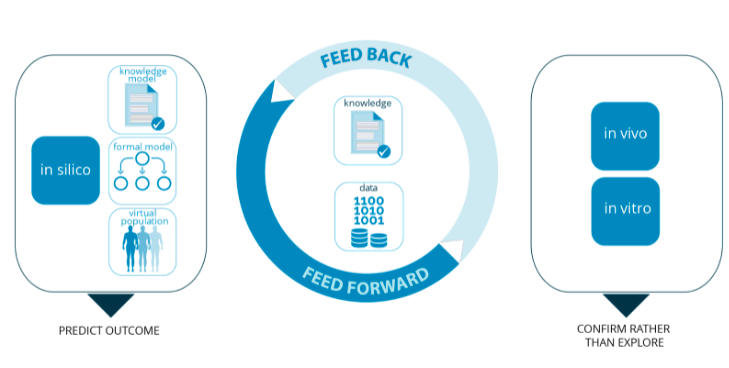
What this sets up is a self-reinforcing crosstalk. Hypotheses are tested in silico first. In vitro and in vivo studies then generate new data and knowledge, which improve the disease and treatment models and the associated VP (Figure 1). The paradigm shift is that traditional studies become confirmatory of in silico trials rather than exploratory as they are today, and that is how in silico clinical trials can change the R&D paradigm.
There are tangible examples. The immunogenicity of a new recombinant protein was predicted by an in silico model and later confirmed in a dedicated clinical trial[23]. A dynamic biomarker of poor prognosis in neuroblastoma patients was identified by running a computational model of the network regulating stress signalling through the c-Jun N-terminal kinase (JNK) pathway, and later confirmed in a cohort of patients[24]. That model-based biomarker predicted better than the biomarkers in use[24:1] [25]. Dronne et al., mentioned above, showed by simulation the limits of current animal models for selecting neuroprotective agents worth taking into clinical development[17:2]. Had manufacturers run that in silico test at the time, their bench-to-bedside decision would have rested on firmer evidence, and the wasted time and money, and more importantly the uninformative and therefore unethical patient contributions, would have been avoided.
Because it demands rigor and careful curation of the knowledge that goes into a disease model, the in silico approach also helps with the reproducibility crisis, widely accepted as a major obstacle in therapeutic R&D [26] [27] [28] [29]
Figure 1: The continuous crosstalk between in silico, in vitro and in vivo
1. Elisabeth and Robert Badinter. Condorcet, Un intellectuel en politique 1743- 1794, Fayard 1988 ↩︎
2. Note: The reverse movement presided over the birth of mathematics which is at the origin only a schematic representation of reality, i.e. a model ↩︎
3. Definition of Nosology on Wikipedia (opens new window)↩︎
4. Clyde, R. G., Bown, J. L., Hupp, T. R., Zhelev, N. & Crawford, J. W. The role of modeling in identifying drug targets for diseases of the cell cycle. J. R. Soc. Interface 3, 617–627 (2006) ↩︎ ↩︎ ↩︎
5. Viceconti, M., Henney, A. & Morley-Fletcher, E. in silico Clinical Trials: How Computer Simulation will Transform the Biomedical Industry. (Research and Technological Development Roadmap, Avicenna Consortium, Brussels, 2016). doi:10.13140/RG.2.1.2756.6164 ↩︎ ↩︎
6. Bosley J, Boren C, Lee S, Grotli M, Nielsen J, Uhlen M, Boren J, Mardinoglu A. Improving the economics of NASH/NAFLD treatment through the use of systems biology. Drug Discov Today 22: 1532 – 1538 (2017) ↩︎
7. Zhang C, Bjornson E, Arif M, Tebani A, Lovric A, Benfeitas R, Ozcan M, Juszczak K, Kim W, Kim JT, Bidkhori G, Ståhlman M, Bergh P-O, Adiels M, Turkez H, Taskinen M-R, Bosley J, Marschall H-U, Nielsen J, Uhlén M, Borén J, Mardinoglu A. The acute effect of metabolic cofactor supplementation: a potential therapeutic strategy against non‐alcoholic fatty liver disease. Mol Syst Biol; 16: e9495 (2020) ↩︎
8. Tomlin, C. J. & Axelrod, J. D. Biology by numbers: mathematical modeling in developmental biology. Nat. Rev. Genet. 8, 331–340 (2007) ↩︎ ↩︎ ↩︎
9. Schmidt, B. J. Systems biology for simulating patient physiology during the postgenomic era of medicine. CPT pharmacometrics & Syst. Pharmacol. 3, e106 (2014) ↩︎
10. Boissel, J.-P., Auffray, C., Noble, D., Hood, L. & Boissel, F.-H. Bridging Systems Medicine and Patient Needs. CPT Pharmacometrics & Syst. Pharmacol. 4, 135–145 (2015) ↩︎
11. Milligan, P. a et al. Model-based drug development: a rational approach to efficiently accelerate drug development. Clin. Pharmacol. Ther. 93, 502–514 (2013) ↩︎ ↩︎ ↩︎
12. Langley JN. On the reaction of cells and of nerve-endings to certain poisons, chiefly as regards the reaction of striated muscle to nicotine and to curare. J. Physiol., 1905, 33: 374–413. ↩︎
13. Note: Mode of action of a compound: the way it interacts with its biological target. The mechanism of action of the compound is downstream from this interaction: it involves all the biologicals (biochemical pathways, cellular interactions, physiological regulations) that carry the desired effect(s). ↩︎
14. Billy F, Ribba B, Saut O, Morre-Trouilhet H, Colin T, Bresch D, Boissel JP, Grenier E, Flandrois JP.. A pharmacologically based multiscale mathematical model of angiogenesis and its use in investigating the efficacy of a new cancer treatment strategy. J. Theor. Biol. 260, 545–562 (2009) ↩︎
15. Byrne, H. M. Dissecting cancer through mathematics: from the cell to the animal model. Nat. Rev. Cancer 10, 221–230 (2010) ↩︎
16. Duval V, Chabaud S, Girard P, Cucherat M, Hommel M, Boissel JP. Physiologically based model of acute ischemic stroke. J Cereb Blood Flow Metab 8,1010-8 (2002) ↩︎
17. Dronne, M. A., Grenier, E., Chapuisat, G., Hommel, M. & Boissel, J. P. A modeling approach to explore some hypotheses of the failure of neuroprotective trials in ischemic stroke patients. Progress in Biophysics and Molecular Biology 97, 60–78 (2008) ↩︎ ↩︎ ↩︎
18. Chabaud, S., Girard, P., Nony, P. & Boissel, J. P. Clinical trial simulation using therapeutic effect modeling: application to ivabradine efficacy in patients with angina pectoris. J Pharmacokinet Pharmacodyn 29, 339–363 (2002) ↩︎ ↩︎ ↩︎
19. Schmidt, B. J. et al. Development of a Quantitative Systems Pharmacology Platform to Support Translational Research and Clinical Development in Immuno-Oncology. J. Pharmacokinet. Pharmacodyn. (2015) ↩︎ ↩︎
20. Von Dassow, G., Meir, E., Munro, E. M. & Odell, G. M. The segment polarity network is a robust developmental module. Nature 406, 188–192 (2000) ↩︎
21. Noble, D. From the Hodgkin-Huxley axon to the virtual heart. J Physiol. 2007; 580: 15–22 ↩︎
22. Mirams, G. R., Davies, M. R., Cui, Y., Kohl, P. & Noble, D. Application of cardiac electrophysiology simulations to pro-arrhythmic safety testing. British Journal of Pharmacology 167, 932–945 (2012) and https://www.fda.gov/drugs/regulatory-science-action/impact-story-improved-assessment-cardiotoxic-risk-drug-candidates-comprehensive-vitro-proarrhythmia ↩︎
23. Koren, E. et al. Clinical validation of the ‘in silico’ prediction of immunogenicity of a human recombinant therapeutic protein. Clin. Immunol. 124, 26–32 (2007) ↩︎
24. Fey, D. et al. Signaling pathway models as biomarkers : Patient-specific simulations of JNK activity predict the survival of neuroblastoma patients. Science (80-. ). 8, RA130 (2015) ↩︎ ↩︎
25. Kim, J. & Schoeberl, B. Beyond static biomarkers—The dynamic response potential of signaling networks as an alternate biomarker? Sci. Signal. 8, fs21–fs21 (2015) ↩︎
26. Pashler, Harold; Wagenmakers, Eric Jan (2012). "Editors' Introduction to the Special Section on Replicability in Psychological Science: A Crisis of Confidence?". Perspectives on Psychological Science. 7 (6): 528–530. doi:10.1177/1745691612465253. PMID 26168108. S2CID 26361121 ↩︎
27. Ioannidis, JPA (2016). "Why Most Clinical Research Is Not Useful". PLOS Med. 13 (6): e1002049. doi:10.1371/journal.pmed.1002049. PMC 4915619. PMID 27328301 ↩︎
28. Stupple, A., Singerman, D. & Celi, L.A. The reproducibility crisis in the age of digital medicine. npj Digit. Med. 2, 2 (2019). https://doi.org/10.1038/s41746-019-0079-z ↩︎
29. Freedman, L. P., Cockburn, I. M. & Simcoe, T. S. The Economics of Reproducibility in Preclinical Research. PLOS Biol. 13, e1002165 (2015) ↩︎