Part 4. Responders: the M&S perspective
TL;DR
Identifying responders is one of the most promising contributions M&S makes to R&D, and it borders on personalized medicine.
Responders are the patients who would die on placebo and survive on the experimental treatment. They can also be defined through the EM and the Absolute Benefit.
Identifying responders is one of the most promising contributions M&S makes to R&D, and it borders on personalized medicine.
What a responder is
Current medical terminology defines response to a treatment as a favorable course once the treatment has been given. That wording implies a causal link between treatment and improvement. Since the causal link can rarely be established, even in very severe disease, "response", and "responder" for the patient, is misleading. A better definition is needed.
Assume the treatment is expected to prevent a yes/no event such as death. A responder is a patient who would experience the event untreated and will not experience it treated.
Table 3 applies that definition to a number of fictitious patients (N), whose condition progresses once without treatment and once with it. Among those N patients, "b" are responders. In the usual and misleading clinical shorthand, (b + d) are called responders, which is correct only if c = 0, a rare setting and a hard one to prove[1]. The definition is easy to apply in an in silico controlled trial and impossible in a real-life trial, unless the event of interest is recurrent.
Table 3: definition of responders
Legend: (see text) among N patients, when untreated, (a + b) experience the event; with the treatment, only “b” does not experience the event. “b” are the responders to the treatment.
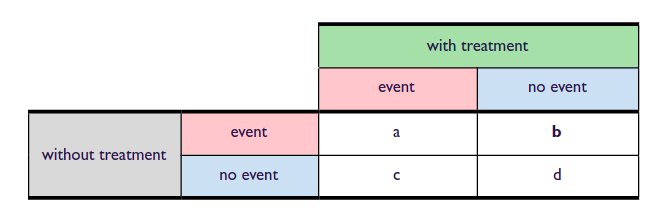
In a two-arm parallel placebo-controlled RCT with mortality as the primary outcome, responders are the patients who would die on placebo (P) and survive on the experimental treatment (T). This too is hard to apply in real life, but for a different reason: how do you predict that a given patient is a responder? It assumes the new treatment beats the control for at least a few patients, or even one. The section below shows the problem.
M&S gets around it, because the same virtual patient can be simulated in each arm, which makes the definition in Figure 3 applicable. That works only where the occurrence of the event can be simulated. Everywhere else, surrogate definitions are needed (see below).
Number of responders in a two-arm RCT
Table 4 gives fictitious numbers of event-free patients and patients who had the event, for a completed real two-arm RCT. At baseline the two groups are assumed comparable thanks to randomization [2]. Concealed randomization is really aimed at producing two groups comparable on average, but here we assume all patients in the trial are similar, that is, exchangeable. The event rates are Rc = a/Nc in the control group and Rt = b/Nt in the new treatment group. Efficacy is measured by the Absolute Benefit, AB = Rc - Rt, or by any other efficacy metric[3].
Table 4: responders in a RCT
Legend: summary data of a completed RCT
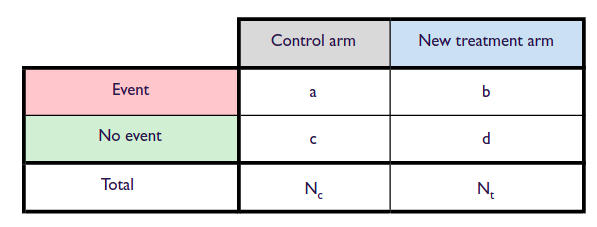
If the new treatment is efficacious, the true Rc is greater than the true Rt.
Identifying responders in this trial under the definition above forces us to assume all patients in it are identical. The number of responders in the treatment arm is then (Rc - Rt)∗Nt, and they sit among the 'd' patients in that arm who had no event. The other 'd' patients are those who would not have had the event without the new treatment either. The total number of responders in the trial, the responders in the treatment arm plus the potential responders in the control arm, is (Rc - Rt)∗( Nc + Nt).
This shows that you cannot say accurately whether a given patient who did not experience the event, at the end of a trial or after a course of therapy, is a responder.
Other definitions of responders
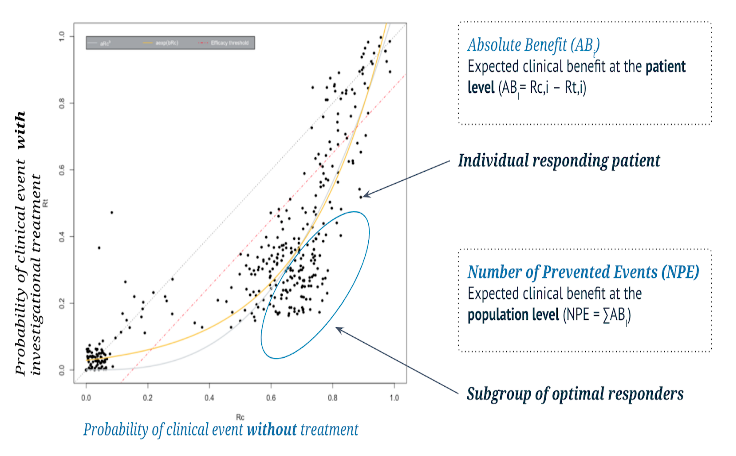
Other definitions exist, depending on the objective. Figure 7 illustrates two.
- Absolute Benefit greater than a threshold "s". Every patient with a predicted AB > s counts as a responder. This suits treatments whose adverse events carry a burden judged at most equivalent to "s".
- Location of responders on a chart of the treatment effect model. This still rests on the predicted Absolute Benefit.
Figure 7: two other definitions of responders: 1) AB greater than a threshold value “s”: all patients, represented by dots, are below the dotted red line offset to the right of the bisector (vertical distance from the bisector = s); 2) graphical location: example, the dots that fall inside the ellipse (the “optimal responders” in this example).
1. To use an analogy often used by detractors of controlled testing, even jumping from a plane without a parachute does not result in death 100% of the time. There are at least 3 cases of airmen who came out of a jump without a parachute in the archives of the Second World War. ↩︎
2. There is a lot to say about this hypothesis of identity guaranteed by randomization. We will talk about it again later. ↩︎
3. Boissel JP, Cogny F, Marko N, Boissel FH. From Clinical Trial Efficacy to Real-Life Effectiveness: Why Conventional Metrics do not Work. Drugs, Real World Outcomes 2019 ; 6, 125–132 ↩︎