The philosophy of Kōhai
Overview
Kōhai is the AI assistant embedded within Jinkō (www.jinko.ai), a secure, cloud-based platform for in silico clinical trial modeling and simulation. Jinkō’s core functionality (model design, virtual population management, trial design, simulation execution, and result analysis) operates entirely independently of any AI. Kōhai exists to accelerate and facilitate human workflows, never to replace the human in the loop.
You can find out more about Kōhai's features in the Kohai overview section.
Name and philosophy
Kōhai (後輩) means “junior” in Japanese. In Japanese culture, a kōhai is guided by the senpai (先輩, “senior”), learning through collaboration and mentorship. Similarly, the Kōhai assistant:
- Assists modelers and clinicians by offering suggestions, templates, and shortcuts.
- Respects the user’s autonomy: it cannot perform actions that a user could not perform via the UI or API.
- Keeps the human in control, allowing users to govern the level of autonomy they grant to Kōhai at every step
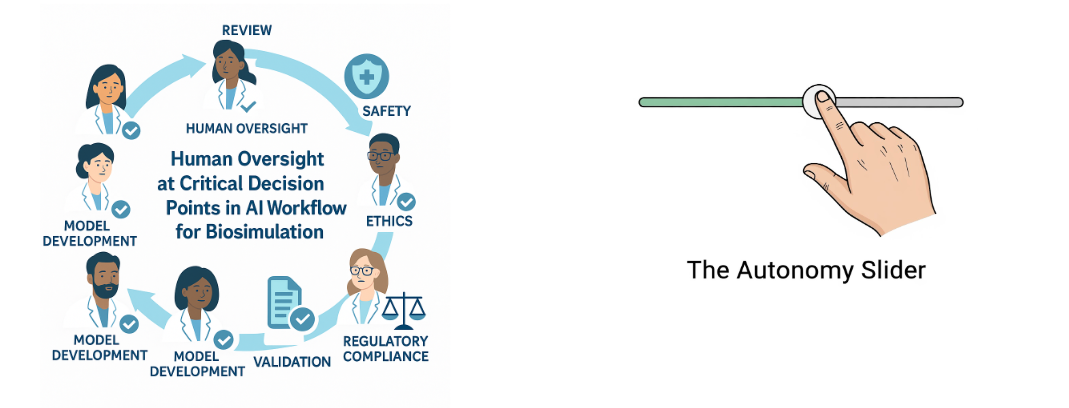
Expert oversight remains essential for Validating model assumptions, Safety and ethical considerations, Handling edge cases and exceptions & Ensuring regulatory compliance
One crucial architectural component in our design is not only how to put humans in the loop but how let them control their autonomy level.
AI accelerators versus direct functionality
All of Kōhai’s recommendations and actions are strictly bounded by what is already available in Jinkō’s interface and API:
- No new capabilities: Kōhai cannot create models, trials, or simulations that a user couldn’t create manually.
- Transparent mapping: Every AI-generated suggestion corresponds to an existing UI/API operation.
- User-driven execution: Kōhai proposes actions (e.g., “run this virtual population simulation with these parameters”), but the user must explicitly confirm before anything is executed.
This design ensures that Kōhai remains an accelerator, not an autonomous agent.
API integration and function calls
Kōhai interfaces with Jinkō exclusively via the platform’s public REST API:
- Function calls: When instructed, Kōhai generates the appropriate API request payload.
- On-behalf execution: After user confirmation, Kōhai submits the call and returns structured feedback.
- Error handling: Any API error is surfaced to the user with actionable guidance.
Because all interactions occur through documented endpoints, Kōhai’s behavior is auditable and fully aligned with Jinkō’s security model.
Data privacy and training
Kōhai is engineered with strict data-privacy guarantees:
- No user data training: It does not train on, store, or derive models from any user-specific data.
- Personal data protection: It never ingests or uses personally identifiable information beyond what is necessary to execute approved API calls.
- Isolation: All inference runs on secure back-end servers, isolated from data pipelines.
Human in the loop and autonomy control
- User triggers every action: Kōhai never acts without explicit user instruction.
- Configurable autonomy: Users choose how much of each workflow to delegate (e.g., draft model code, set up trial arms, analyze outputs).
- Version control: Each action executed via Kōhai creates a new, reversible AI-generated version snapshot in Jinkō’s versioning system.
Versioning and reversibility
To maintain full traceability:
- Every Kōhai action spawns a new resource version labeled
"AI generated". - Users can revert to any prior version in one click.
- The audit log captures: who requested the action, the exact API payload, and timestamp.
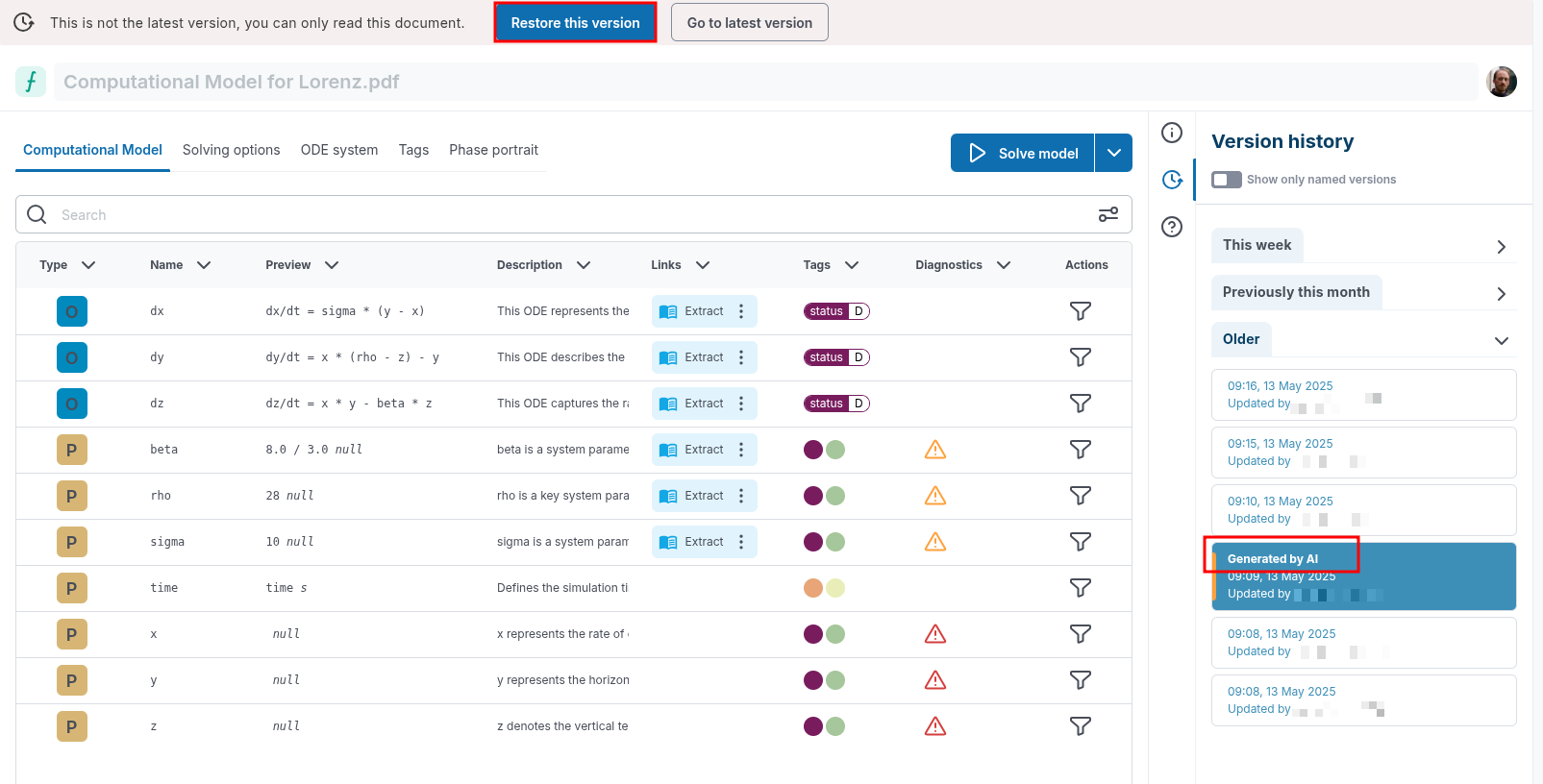
Track with version was AI generated and revert if needed
Core features summary
From our public documentation (platform core AI features):
- Model scaffolding: Generate skeleton Bioluminescent or PK/PD models based on high-level specifications.
- Parameter estimation helper: Suggest suitable population priors and fitting routines.
- Trial design assistant: Propose cohort definitions, dosing regimens, and sampling schedules.
- Simulation explorer: Auto-configure simulation batches across virtual populations.
- Result summarizer: Draft human-readable summaries of simulation outputs, with plots and key metrics.
