Acute Myeloid Leukemia model
Model description: acute myeloid leukemia
Nova’s Acute Myeloid Leukemia model describes the uncontrolled proliferation and accumulation of leukemic blasts, undifferentiated and immature myeloid cells that fail to develop into mature blood cells, leading to a compromised immune system. The model also accounts for the clonal and heterogeneous nature of the disease, with multiple clonal lineages having different phenotypes. Overcrowding in the Bone marrow induces clonal competition especially under treatment-related pressure.
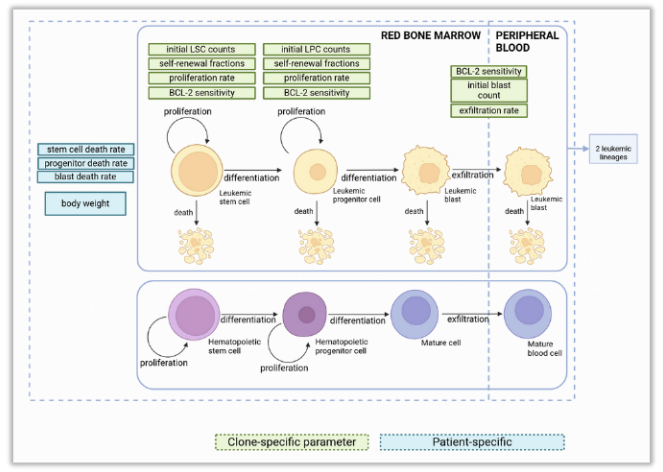
AML submodel inputs & parameters - Leukemic and healthy stem cells self-renew and differentiate into different maturation states in the bone marrow. White blood cells and leukemic blasts finally extravasate in the blood. Created with BioRender.com
💊 Drugs that can be tested
-
Antibody-drug Conjugates
-
BH3-mimetics
-
Bispecific T-cell engagers
-
PROTACs
👥 Model populations of interest
- R/R Acute Myeloid Leukemia
- First-line AML patients
- In the future: different molecular subtypes
📍Possible clinical endpoints
- White blood cell counts
- Blast count in the Bone Marrow
- Blast count change from baseline
- Response
Early insights to optimize your trial design: AML model
Translational aspects
- Translation of the dose-effect relationship from in vitro to an in vivo setting
- Minimal active dose for first-in-human trials
Patient selection
- Identify the set of patient characteristics/biomarkers that define optimal responders to a treatment.
- Investigate between-patient variability of response (extent, duration) and resistance under different pathological and mechanistic assumptions.
Optimization of trial design
- Explore various regimens adjusting parameters (dose, administration frequency, administration route, treatment duration…) running a myriad of different scenarios.
Combination therapies
- Test different schedules in mono and combination therapy and sequences of treatments.
- Explore different target blockade or activation scenarios and identify potential synergies across treatment options.